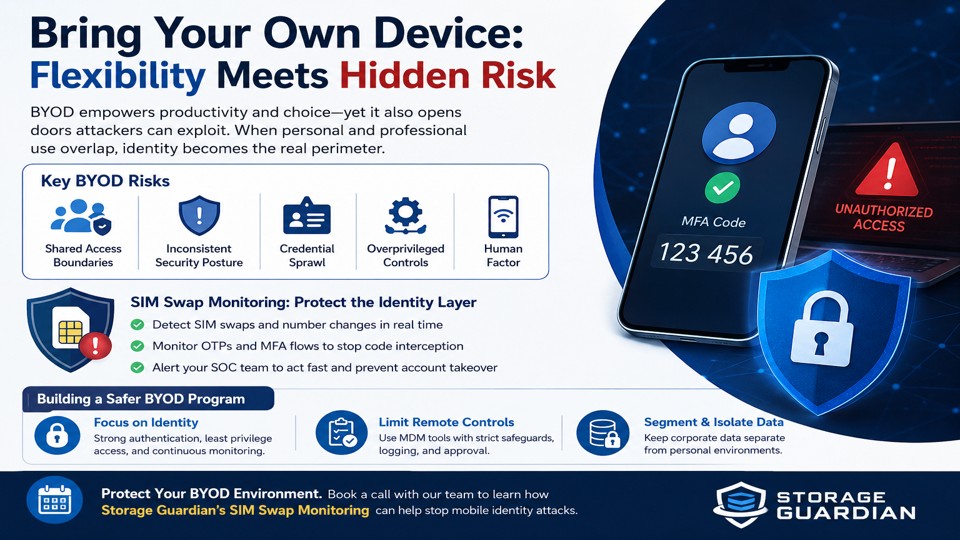
Bring Your Own Device, or BYOD, has changed how organizations work by giving employees the freedom to use the devices they already know and trust. It can improve productivity, reduce hardware costs, and make remote work feel more natural. But that convenience comes with a less visible trade-off when personal and professional use overlap, security risks become harder to control.
At first glance, BYOD seems like a clear win. Employees enjoy flexibility, while organizations avoid the cost and overhead of managing company-owned hardware. The challenge is that the same features that make BYOD appealing, such as device autonomy, remote access, and user control, also create openings that attackers can exploit.
The Stryker Lesson
A useful example comes from the medical device manufacturer Stryker. What was initially believed to be a ransomware incident was later understood to be something different, systems were remotely wiped rather than encrypted for ransom. That distinction matters because it suggests the destructive action may have come from someone with access to legitimate administrative tools, or someone who had compromised that access.
This is the core danger in BYOD environments. Organizations often depend on mobile device management tools or similar controls to enforce security policies on personal devices. Those tools can include powerful capabilities, such as locking or wiping a device remotely. That is useful if a phone is lost or stolen, but it also means the same control can become dangerous if credentials are compromised, policies are misconfigured, or privileges are abused.
The Stryker case is a reminder that not every major incident depends on sophisticated malware. Sometimes the most effective weapon is a legitimate tool used in the wrong hands.
Why BYOD Expands Risk?
BYOD increases exposure in several ways:
• Shared access boundaries, because personal devices may be used by family members or connected through less secure networks.
• Inconsistent security posture, because users do not all maintain the same update habits, antivirus coverage, or safe-use practices.
• Credential sprawl, because access to corporate systems increasingly extends beyond office networks.
• Overprivileged controls, because mobile management platforms and admin accounts can grant sweeping powers if they are not tightly governed.
The human factor is also important. A personal device is not just a work tool; it is part of daily life. Apps, downloads, messaging, and casual browsing all sit alongside work access. That blend increases the chances of phishing, credential theft, or accidental exposure. Even simple actions like installing a new app or using public Wi-Fi can create risk if the device also holds access to corporate data.
Identity Becomes The Perimeter
In a BYOD environment, the old perimeter-based model of security breaks down. The device matters, but identity matters more. If an attacker can steal credentials or hijack an authentication method, the physical device itself may not be the main weakness.
That is why SIM swapping has become such an important threat to watch. When an attacker takes control of a user’s mobile number, they may be able to intercept one-time passcodes, reset passwords, and bypass multi-factor authentication. In a BYOD setting, where personal phones often serve as the bridge into work systems, that kind of attack can be especially damaging.
This is where Storage Guardian’s SIM Swap Monitoring becomes relevant. It is designed to detect changes that may indicate a phone number has been moved to a new SIM, which can be a sign of account takeover or fraud. It also helps monitor one-time passwords and multi-factor authentication flows so bad actors cannot intercept and exploit security codes.
How SIM Swap Monitoring Helps?
Storage Guardian’s SIM Swap Monitoring adds visibility to a part of the attack surface that is often overlooked. Because many employees use their personal phones for authentication and account recovery, a SIM swap can let an attacker intercept codes and exploit the very systems meant to keep access secure.
The value of this kind of monitoring is speed. Storage Guardian SIM swap notifications can be sent to the SOC team so they can lock down infrastructure associated with MFA and coordinate a response quickly. It also emphasizes monitoring major mobile networks and receiving alerts in real time, which helps teams act before suspicious activity turns into broader compromise.
This is especially useful in BYOD programs because the mobile device is not just an endpoint; it is part of the trust chain. If the mobile number is compromised, the attacker may be able to move from the personal side of the device into corporate systems without ever needing to defeat endpoint protections directly.
Building A Safer BYOD Program
Organizations do not need to abandon BYOD to reduce risk. The better approach is to manage the trust model more carefully.
First, shift the focus from device trust to identity and access management. Strong authentication, least-privilege access, and continuous monitoring are essential. Second, limit the scope of remote-control tools. Just because a system can wipe a device does not mean it should be able to do so without strict safeguards, logging, and approval controls. Third, segment data wherever possible so corporate information is isolated from personal environments.
It also helps to treat SIM swap monitoring as part of a layered defense strategy. MFA remains important, but the delivery channel behind MFA must be protected too. Monitoring for mobile identity abuse adds an extra layer of awareness that can make a major difference when attackers target the phone number rather than the device.
Transparency And Shared Responsibility
Employees need to understand what level of control the organization has over their devices and what risks come with using a personal phone for work. If people know how MDM tools work, how authentication is protected, and why mobile number changes matter, they are more likely to make safer decisions.
Security in BYOD is not just a technical issue. It is also a policy issue, a trust issue, and a communication issue. Organizations that clearly explain their controls and their expectations are better positioned to build a BYOD program that is both usable and resilient.
Closing Perspective
BYOD is not inherently unsafe. When implemented thoughtfully, it can support modern work in a flexible and efficient way. But it also changes where the real risk lives. The most dangerous weakness may not be the phone itself; it may be the identity, access, and recovery systems attached to it.
That is why cases like Stryker are so important. They show that flexibility always comes with trade-offs, and that the tools used to manage convenience can become vectors for disruption if they are not carefully governed. With stronger identity controls and monitoring solutions like Storage Guardian’s SIM Swap Monitoring, organizations can keep the benefits of BYOD without losing sight of the risks.
Book a call with our team to learn how Storage Guardian’s SIM Swap Monitoring can help protect your BYOD environment from mobile identity attacks.


