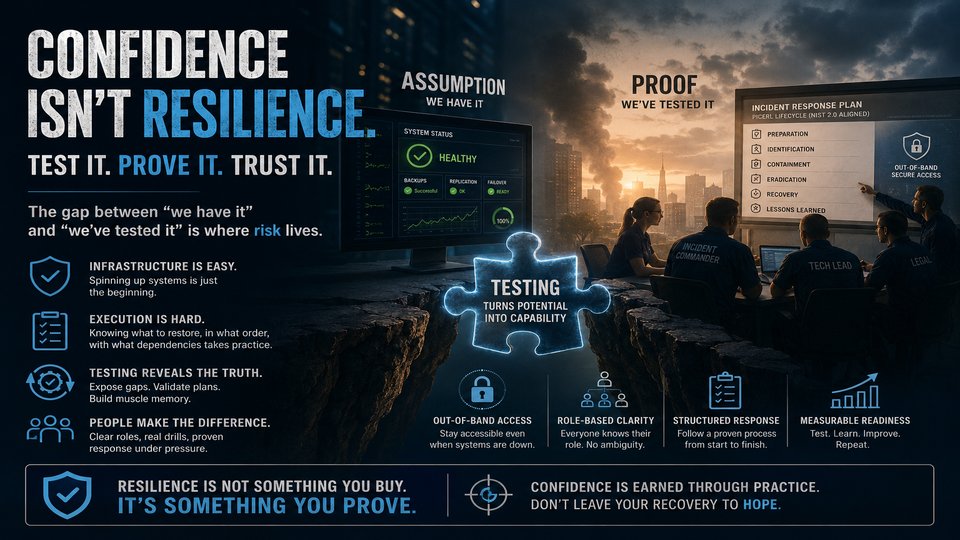
There’s a comforting assumption in modern IT if you’re paying for backup systems, cloud failover, or disaster recovery infrastructure, you’re covered. Servers can spin up on demand, environments replicate in minutes, and dashboards glow green with “healthy” status indicators. It creates the impression that resilience is a solved problem.
But that sense of security is often an illusion. Buying the capability to recover is not the same as being able to recover.
Organizations today invest heavily in backup platforms, secondary environments, and automated recovery tools. On paper, everything checks out. Data is replicated. Snapshots run on schedule. Failover systems are in place.
Yet when a real incident strikes whether ransomware, accidental deletion, or a malicious insider many teams confront a hard truth they’ve never actually proven their recovery plan works.
The gap between “we have it” and “we’ve tested it” is where risk lives.
Recovery is not just about infrastructure; it’s about execution under pressure. Can your team restore critical systems in the right sequence? Are dependencies clearly documented, or do they exist only as tribal knowledge? Do your backups include everything required to fully restore operations or just most of it?
These questions are not theoretical. They only get answered when you simulate failure.
Too often, disaster recovery is treated like insurance: something you pay for and hope you never need. But unlike insurance, recovery systems degrade silently. Configurations drift. Credentials expire. Environments evolve. What worked six months ago may not work today.
And when failure happens, it rarely unfolds neatly. It’s chaotic, time-sensitive, and unforgiving.
This is why testing is not optional it is the only way to turn potential into capability.
A proper recovery drill forces reality into the equation. It exposes hidden dependencies, outdated documentation, and flawed assumptions. It reveals whether your team can actually execute the plan or if they’re encountering it for the first time during a crisis. Most importantly, it builds muscle memory. In an incident, speed and clarity matter more than perfect tools.
Consider a common scenario: a company relies on automated cloud backups and sees successful job logs every night. Confidence is high until a critical system fails. During recovery, they discover key application configurations were never backed up. Restoring the database alone isn’t enough to bring the service online. What appeared to be a complete safety net turns out to be partial at best.
This is not a failure of technology. It is a failure of validation.
The uncomfortable truth is that spinning up infrastructure is the easy part. Knowing exactly what to restore, in what order, with what dependencies, and under what constraints that’s the hard part. And the only way to get it right is through practice.
From Assumption to Proof if organizations want real resilience, they need to rethink their approach:
• Treat recovery plans as living systems, not static documents.
• Schedule regular drills that simulate real-world scenarios, not ideal conditions.
• Involve the actual responders, not just the system architects.
• Measure recovery performance honestly, even when results are uncomfortable.
Resilience is not something you buy. It’s something you prove. The Missing Piece: A Role-Based, Out-of-Band Incident Response Planner (NIST 2.0 Aligned)
Even the most well-tested incident response plans can fail if teams cannot access them when they are needed most. During many cyberattacks especially ransomware events core systems, documentation, and communication tools are often unavailable or compromised.
Storage Guardian’s NIST 2.0-aligned, CIS-compliant Incident Response Planner addresses this gap by providing a secure, out-of-band platform for managing incidents. It enables SOC and NOC teams to activate stakeholders, conduct tabletop exercises, and coordinate the full incident lifecycle from preparation through to lessons learned without relying on affected production systems.
By separating response plans from operational environments and organizing them around clearly defined roles, organizations can:
• Maintain access to critical recovery instructions, even during a full system compromise
• Eliminate ambiguity by assigning clear responsibilities
• Ensure consistent execution of response procedures, regardless of personnel on duty
This role-based, out-of-band approach transforms incident response from a static, document-driven process into a structured and actionable system. It closes the gap between planning and execution at the moment it matters most.
The planner supports the full PICERL lifecycle Preparation, Identification, Containment, Eradication, Recovery, and Lessons Learned while also enabling effective tabletop exercises. This helps organizations validate readiness, strengthen response capabilities, and meet cyber insurance requirements before an incident occurs.
Confidence vs. Hope
The next time you see a dashboard reporting healthy backups or a ready failover environment, ask a simple question: “Have we actually done this?”
If the answer is no, then what you have isn’t confidence it’s hope.
If you’re ready to move beyond assumptions and build proven resilience, schedule a no-obligation consultation with our team at Storage Guardian today.


