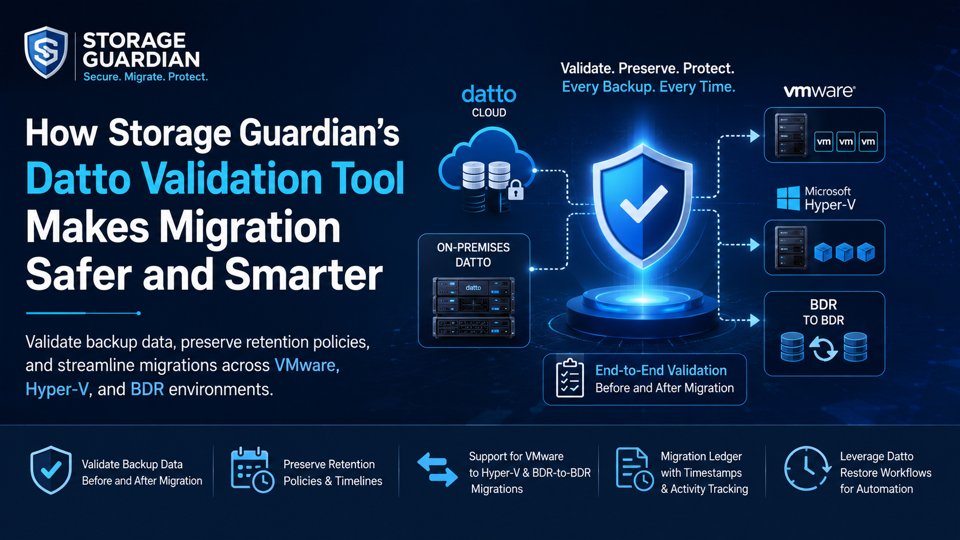
Learn how Storage Guardian’s Datto Validation Tool helps validate backup data, preserve retention policies, and streamline migrations across VMware, Hyper-V, and BDR environments.
Migrating backup data from one environment to another is never just a technical move. It is a business-critical process that requires accuracy, visibility, and confidence that recovery data will still be available when needed. Storage Guardian’s Datto Validation Tool is designed to simplify that process by helping organizations validate data before and after migration while preserving retention policies and restorability.
For IT teams managing complex backup environments, migration can create real risks. Historical backup data may be lost, recovery points may become inaccessible, and retention timelines may be disrupted. The Datto Validation Tool helps reduce those risks by reviewing existing retention policies in both Datto Cloud and on-premises environments, then validating the integrity of backup data using VMware and Hyper-V APIs.
Why Migration Validation Matters?
Before moving workloads between hypervisor hosts or platforms, organizations need a clear plan. A migration that looks successful on the surface can still create hidden issues if backup data is incomplete or recovery options are broken. That is why validation is such an important step.
Storage Guardian’s tool helps organizations confirm that data is not only moved, but also still usable afterward. By checking restorability and preserving retention information, the tool supports a more reliable transition. This is especially important for businesses that cannot afford downtime or data loss during migration.
Key Capabilities
The Datto Validation Tool is built to make a traditionally manual process more efficient and auditable. It can help automate key steps throughout the migration workflow, reducing the chance of human error and improving consistency.
Some of its core capabilities include:
• Validating backup data before and after migration.
• Reviewing retention policies across Datto Cloud and on-premises environments.
• Supporting VMware to Hyper-V and BDR-to-BDR migrations.
• Maintaining a migration ledger with timestamps and activity tracking.
• Using Datto’s built-in restore workflows to automate parts of the process.
These capabilities help teams move workloads with greater confidence while keeping recovery information intact.
One of the biggest advantages of the tool is its ability to preserve both visibility and control. Instead of relying on manual checks, IT teams can use an automated workflow that tracks migration steps and highlights retention points. That makes it easier to estimate timelines, monitor progress, and confirm that critical data remains protected.
The tool also supports secure data portability, which is especially valuable for organizations that need to move between platforms without sacrificing compliance or recovery readiness. Its SaaS-based licensing model can also reduce overhead, making it a practical option for teams that want flexibility without maintaining legacy software.
Built for Confidence
Data migration should not mean guessing whether backup history survived the move. Storage Guardian’s Datto Validation Tool is built to remove that uncertainty by adding structure, automation, and validation to the process. From pre-migration checks to post-migration confirmation, it helps organizations protect the integrity of their backup environment.
For businesses planning a hypervisor migration or transition between BDR systems, the tool offers a safer path forward. It does more than move data it helps ensure the data is still recoverable, compliant, and ready when needed.
Conclusion
Storage Guardian’s Datto Validation Tool gives IT teams a smarter way to manage migration. By validating backup data, preserving retention policies, and automating key workflow steps, it helps reduce risk and improve confidence throughout the process. For organizations that depend on reliable recovery, that kind of validation can make all the difference.


