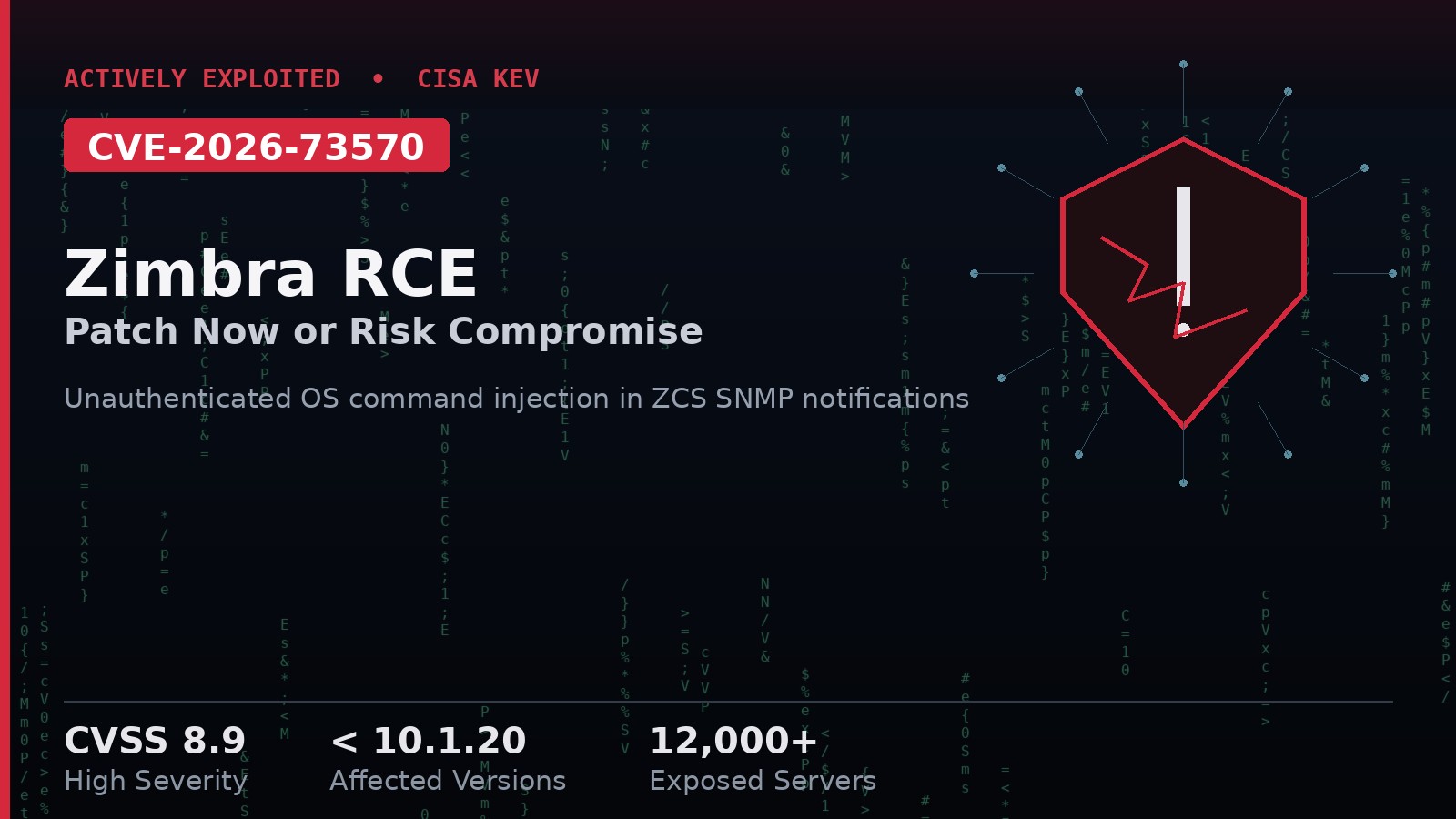
A critical remote code execution (RCE) vulnerability in Zimbra Collaboration Suite (ZCS) is now being actively exploited in the wild, prompting urgent action from CISA and security teams worldwide. If your organization runs internet-facing Zimbra mail servers, immediate patching and hardening are essential to prevent unauthorized access, data exfiltration, and downstream compromise.
What’s the vulnerability?
CVE-2026-73570 is an unauthenticated OS command injection flaw in Zimbra’s SNMP notification component that allows attackers to execute arbitrary operating system commands as the Zimbra service account. The issue arises from improper sanitization of untrusted input during SNMP notification processing, enabling specially crafted SMTP requests to trigger command execution without credentials.
• Severity: CVSS 8.9 (High)
• Affected versions: Zimbra Collaboration Suite prior to 10.1.20
• Prerequisites for exploitation: The optional zimbra-snmp package must be installed and SNMP notifications enabled.
• Exploitation status: Confirmed active exploitation; added to CISA’s Known Exploited Vulnerabilities (KEV) catalog on August 21, 2026
CERT Polska first reported in-the-wild exploitation in mid-August, and CISA subsequently mandated patching for federal agencies within three days.
Why this matter for your business?
Business collaboration platforms like Zimbra often host sensitive communications and integrate with directory services, backup systems, and productivity tools. Successful exploitation can lead to:
• Full server compromise under the Zimbra user context
• Lateral movement into internal networks and connected services
• Data theft, ransomware deployment, or persistent backdoors
With over 12,000 Zimbra servers still exposed online concentrated in Europe and Asia the attack surface remains large and attractive to threat actors.
Immediate actions to take
Follow these steps to reduce risk and align with CISA’s remediation guidance:
1. Patch immediately: Upgrade all Zimbra Collaboration Suite instances to version 10.1.20 or later.
2. Disable unnecessary components: If SNMP notifications are not required, disable them or remove the zimbra-snmp package.
3. Restrict access: Limit exposure of Zimbra management and mail services to trusted networks only.
4. Monitor for signs of compromise: Review Zimbra logs and web application directories for unauthorized file creation, unexpected service restarts, or anomalous processes.
5. Verify patch deployment: Confirm that all managed environments running Zimbra have been updated and validated.
How Storage Guardian supports your response?
When a high-severity, actively exploited vulnerability like CVE-2026-73570 emerges, speed and structure determine outcomes. Storage Guardian’s incident response runbook and Incident Response Planner help teams move from alert to action without missing critical steps.
Incident Response Runbook
Our runbook provides pre-defined, NIST-aligned workflows for common threat scenarios including mail server compromise and RCE events. For Zimbra-specific incidents, the runbook guides teams through:
• Triage and scoping: Quickly identify affected assets, exposure level, and business impact.
• Containment playbooks: Isolate compromised servers, disable vulnerable services, and enforce network restrictions.
• Evidence collection: Standardized log capture, memory snapshots, and timeline reconstruction to support forensics and reporting.
• Recovery validation: Checklists to confirm patch success, service integrity, and safe restoration of normal operations.
Incident Response Planner
The Planner helps security and IT leaders coordinate people, tools, and timelines during an active incident. Key capabilities include:
• Role assignment and communication: Define who does what from patching to legal notification so nothing falls through the cracks.
• Timeline tracking: Log key actions, decisions, and milestones to meet regulatory deadlines (e.g., CISA’s three-day patch window).
• Integration with existing tooling: Connect with your SIEM, ticketing, and backup systems to streamline execution and reporting.
Together, these tools reduce mean time to respond (MTTR), ensure consistent execution across teams, and provide auditable records for leadership and regulators.
Stay ahead of the next Zimbra-style threat
CVE-2026-73570 underscores a broader trend: collaboration platforms are prime targets, and patches alone aren’t enough without a disciplined response process. By combining rapid patching with structured incident response, organizations can limit damage and maintain trust even when attackers move fast.
If you’d like a walkthrough of how Storage Guardian’s runbook and Planner can be tailored to your Zimbra environment, reach out to our team for a consultation.


