When Was the Last Time You Reviewed Your Incident Response Plan?
If it has been a while, your plan may not reflect today’s threats, your current team, or the people who need to be involved when an incident happens.
A strong incident response plan is more than a technical document. It should clearly define roles, communication paths, and decision-making authority, including C-level management so leadership can respond quickly and stay aligned during a crisis.
Why C-Level Involvement Matters?
Cyber incidents move fast, and business decisions often need to happen just as quickly. Executives may need to approve downtime, legal response, customer communication, insurance notifications, or recovery priorities. If they are not included in the plan, response efforts can become slower, less coordinated, and more expensive.
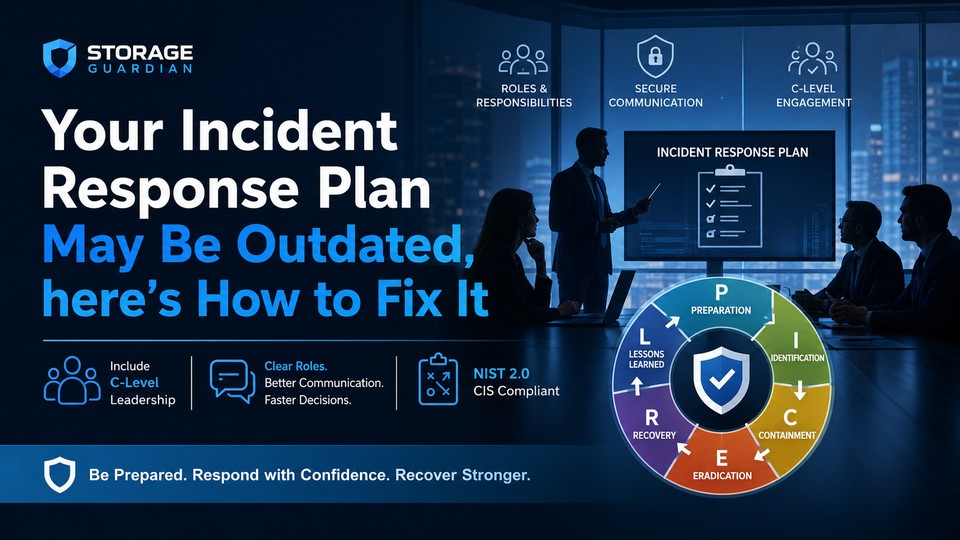
The best plans make it clear who is responsible for what, how stakeholders are notified, and how the organization moves through each stage of the incident lifecycle. Storage Guardian’s approach follows the PICERL framework, covering preparation, identification, containment, eradication, recovery, and lessons learned.
A Better Way to Plan
Storage Guardian’s NIST 2.0 CIS compliant Incident Response Planner helps organizations build and test a more complete response plan inside Acronis Cyber Protect Cloud. It supports stakeholder roles, tabletop exercises, alternative communication channels, and out-of-band coordination so teams can respond even when normal systems are compromised.
This role-based, out-of-band approach transforms incident response from a static, document-driven process into a structured and actionable system. It closes the gap between planning and execution at the moment it matters most.
The planner supports the full PICERL lifecycle Preparation, Identification, Containment, Eradication, Recovery, and Lessons Learned while also enabling effective tabletop exercises. This helps organizations validate readiness, strengthen response capabilities, and meet cyber insurance requirements before an incident occurs.
That matters because incident response is not only about technology recovery. It is about keeping the right people informed, making decisions quickly, and following a repeatable process under pressure. For organizations that want a more practical and NIST-aligned way to prepare, Storage Guardian’s Incident Response Planner offers a structured solution.


