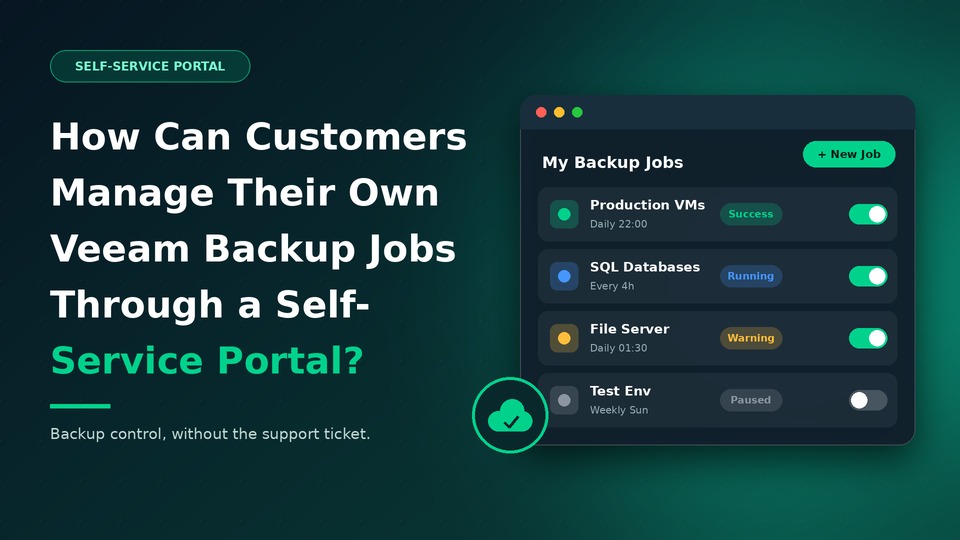
Managing backup infrastructure traditionally requires customers to rely on IT teams or managed service providers for routine changes. With the growing adoption of Veeam Backup & Replication, organizations are increasingly looking for simpler ways to control backup operations while maintaining security, reliability, and centralized oversight.
A self-service Veeam backup portal can provide customers with greater visibility and control over their backup environment without requiring direct access to the underlying infrastructure.
What Is a Self-Service Backup Portal?
A self-service backup portal is a web-based interface that allows authorized customers to manage selected backup functions independently. Instead of submitting a support request for every change, customers can access their backup environment through a controlled portal.
Depending on the service configuration, customers may be able to:
• View active and completed backup jobs
• Monitor backup status and recent failures
• Start or stop authorized backup jobs
• Review protected workloads and storage usage
• Request or initiate backup-related changes
• Access backup reports and notifications
• Monitor recovery points and retention information
This approach can significantly reduce administrative overhead while giving customers better visibility into their data protection environment.
How Does Self-Service Veeam Management Work?
A self-service portal can sit between the customer and the underlying Veeam backup infrastructure. Role-based access controls ensure that customers can perform only the operations permitted for their environment.
For example, a customer may have permission to run an existing backup job but not modify global Veeam configuration, repositories, credentials, or other customers' data.
This separation is particularly important for managed backup services, where multiple customers share centralized infrastructure. Customers receive the convenience of self-service access while the service provider maintains control over the underlying
platform.
Storage Guardian: Simplifying Veeam Backup Management
Storage Guardian can help organizations transition from traditional provider-managed backup operations toward a more flexible self-service model.
Through a customer-focused portal and managed Veeam environment, Storage Guardian can provide customers with greater visibility into their backup operations while maintaining centralized monitoring and support.
This model allows organizations to handle routine backup activities more efficiently while Storage Guardian's technical team remains available for infrastructure management, troubleshooting, monitoring, and advanced recovery requirements.
The result is a balance between customer control and professional backup management.
Why Self-Service Backup Matters? Self-service access can provide several operational benefits:
Faster response: Customers can perform permitted backup actions without waiting for a support ticket.
Greater visibility: Real-time or near-real-time information helps customers understand whether their workloads are protected.
Reduced administrative workload: IT teams and managed service providers can spend less time handling routine requests.
Improved accountability: Role-based permissions create a controlled environment where backup activities can be managed by authorized users.
Scalable backup operations: As organizations add workloads, a self-service approach can make backup management easier to scale.
Build a More Flexible Veeam Backup Strategy
Modern businesses need backup solutions that provide both reliable data protection and operational flexibility. A self-service portal can give customers greater control over their Veeam backup jobs without compromising centralized management and security.
With Storage Guardian's managed backup services and Veeam-based infrastructure, organizations can gain improved visibility, streamlined backup operations, and access to professional support when they need it.
For businesses looking to modernize their backup environment, self-service Veeam management can be an important step toward a more efficient and customer-focused data protection strategy.


