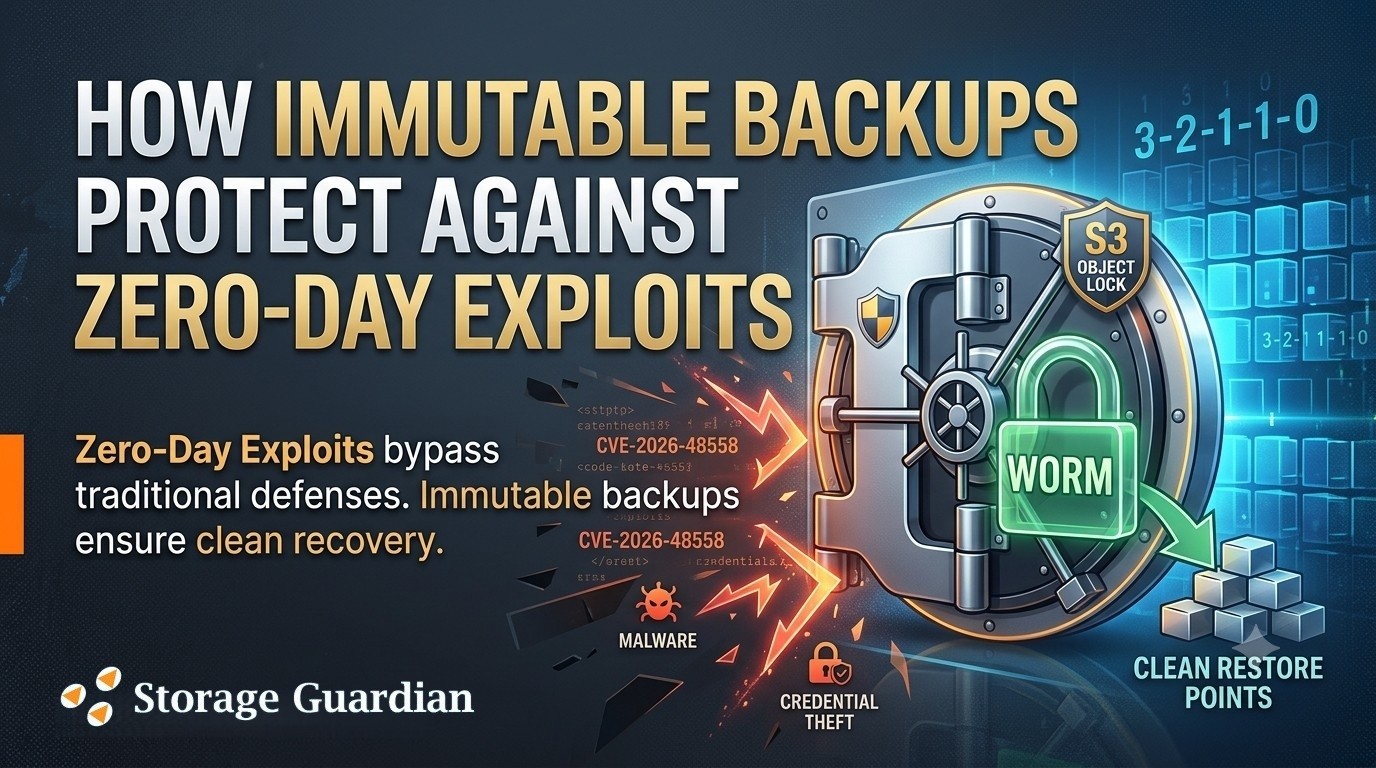
Zero-day exploits bypass traditional defenses by targeting unknown vulnerabilities but immutable backups ensure you can always recover to a clean, uncorrupted state, even when no patch exists yet. In June 2026, attackers exploited CVE-2026-48558 a critical authentication bypass in the SimpleHelp remote monitoring and management platform to impersonate a trusted technician and gain unrestricted access.
Leveraging this foothold, they deployed two previously unseen malware strains TaskWeaver and Djinn Stealer.
What made this incident especially dangerous was its lateral impact. Djinn Stealer was engineered to harvest credentials across cloud logins, cryptocurrency wallets, and access tokens for AI development tools. As Black Point’s Adversary Pursuit Group noted, “Whoever holds those keys inherits everything those keys unlock.”
Critically, simply isolating the infected machine wasn’t enough. The credentials exfiltrated during execution could be reused to re-enter the environment long after the malware was removed.
This scenario underscores why prevention alone isn’t sufficient you need a recovery strategy that assumes breach and preserves clean restore points no attacker can alter or delete.
Why immutable backups matter for zero-days?
Zero-day attacks exploit software flaws before vendors release patches, leaving organizations exposed until fixes are available. Immutable backups counter this by enforcing Write-Once-Read-Many (WORM) storage, ensuring backup data cannot be modified, encrypted, or deleted even by compromised admin accounts.
Key benefits include:
· Air-gap like protection: Immutable repositories act as logical air gaps, preventing ransomware or malicious insiders from tampering with restore points.
· Fast recovery without negotiation: When zero-day compromises production systems, you can restore from a known good backup instead of waiting for a patch under active exploitation.
· Defense in depth: Combined with segmentation and edge protections (like WAFs), immutable backups form the final pillar of a resilient zero-day strategy.
Storage Guardian + Veeam Insider and Outsider Protection
Storage Guardian enhances Veeam deployments with layered protections designed for both malicious insiders and external attackers:
Insider Protection
· Preserves previous backup versions in a secure “recycle bin,” allowing restoration even if current backups are accidentally or intentionally deleted.
· Configurable retention (1–99 days) ensures you can roll back to a pre-compromise state.
· Ideal for scenarios where credential theft leads to backup deletion or corruption.
Outsider Protection
· Provides API-free, cost-effective data copies (<$0.09 per protection) that bypass common integration vulnerabilities.
· Enforces a Zero Trust model by isolating backup copies from production environments and requiring strict verification for access.
· Integrates with ConnectWise for streamlined billing and ticketing while maintaining security boundaries.
Together, these features ensure that even if an attacker gains trusted access your recovery path remains intact and untampered.
Building a zero-day resilient backup strategy
To maximize protection:
· Enable immutability: Use object storage with S3 Object Lock or Veeam’s hardened repositories to enforce WORM policies.
· Follow 3-2-1-1-0: Keep 3 copies, on 2 media types, 1 offsite, 1 immutable/air-gapped, and 0 errors in restore tests.
· Test restores quarterly: Validate that backups can recover business critical workloads within your RTO/RPO targets.
· Layer with Zero Trust: Combine immutable backups with network segmentation, MFA, and least privilege access to limit blast radius.
In a world where zero-days and credential theft are inevitable, immutable backups aren’t just a best practice they’re your last line of defense


