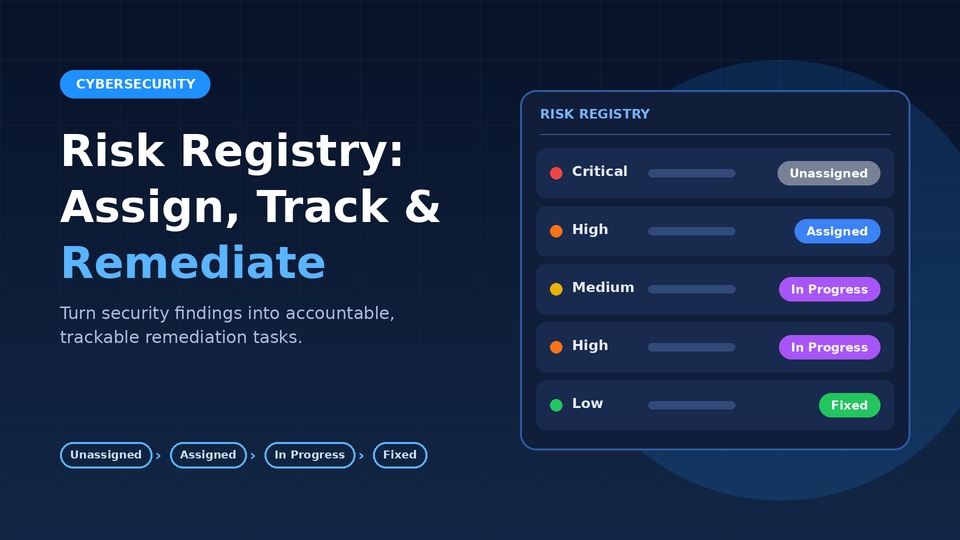
Effective cybersecurity risk management requires more than identifying vulnerabilities and compliance issues. Organizations also need a structured process to assign, track, reassign, and remediate risk registry issues before they become larger security or compliance problems.
A centralized Risk Registry can help security teams transform findings from vulnerability scans, compliance assessments, penetration tests, and security tools into actionable tasks with clear ownership and accountability.
What Is a Risk Registry?
A Risk Registry is a centralized system for recording and managing identified cybersecurity risks. Instead of allowing findings to remain scattered across security tools, spreadsheets, emails, and reports, organizations can consolidate them into a structured workflow.
A well-designed Risk Registry should capture information such as:
• Risk or vulnerability description
• Source of the finding
• Severity or priority
• Assigned owner
• Current status
• Recommended remediation
• Remediation strategy
• Resolution date
• Evidence of remediation
This creates a clear record of what risks exist, who is responsible for them, and what actions have been taken.
How Should Risk Issues Be Assigned?
Every identified risk should have a clearly defined owner. Without ownership, even high-priority vulnerabilities can remain unresolved.
Storage Guardian's Risk Registry solution can help organizations organize findings and assign them to the appropriate team member. Default assignees can be configured for specific categories of findings, while authorized users can manually reassign an issue when another individual or department is better positioned to address it.
For example, a compliance issue identified by a NINJA assessment may initially be assigned to a security administrator, while a vulnerability requiring an application change may need to be reassigned to a development team.
Clear assignment creates accountability and reduces the possibility of security findings being overlooked.
How Can Risk Issues Be Tracked?
Assignment is only the beginning. Organizations need visibility into the entire remediation lifecycle.
A centralized Risk Registry can use statuses such as:
Unassigned → Assigned → In Progress → Fixed
This workflow provides security and management teams with an immediate understanding of outstanding risks.
Automated notifications can also help keep responsible personnel informed when new issues are assigned or when action is required. Instead of manually monitoring multiple spreadsheets or security platforms, teams can use a centralized dashboard to track open and resolved findings.
When Should a Risk Be Reassigned?
Risk ownership can change as an investigation progresses. An issue may initially be assigned to one employee but later require expertise from another team.
For example, a vulnerability discovered through a penetration test may require reassignment from the security team to a system administrator. A compliance finding may similarly need to be transferred to an HR, IT, or operations representative.
Storage Guardian's Risk Registry workflow supports reassignment so organizations can maintain accurate ownership while preserving the history and status of the risk.
How Should Risk Remediation Be Documented?
Remediation should be more than simply changing an issue's status to "Fixed." Organizations should document how the issue was addressed, including the remediation strategy and supporting evidence where appropriate.
This creates an auditable history that can be useful during security assessments and compliance audits.
Storage Guardian can help centralize remediation information across findings from security and compliance tools, making it easier to demonstrate that identified issues were investigated and addressed.
How Can Organizations Confirm That Risks Are Resolved?
Continuous security monitoring is important because a previously resolved issue can reappear during a subsequent scan.
A mature Risk Registry process should compare new assessment results with previous findings and help identify which issues remain unresolved, which have been remediated, and which are newly discovered.
This approach gives organizations a more accurate view of their current security posture.
Strengthen Risk Management with Storage Guardian
Managing cybersecurity risks manually can create unnecessary administrative work and make it difficult to maintain accountability. Storage Guardian's Risk Registry solution provides a centralized approach for assigning, tracking, reassigning, and documenting remediation activities.
By connecting security findings with responsible owners and measurable remediation workflows, organizations can improve visibility, accountability, and audit readiness while creating a more structured approach to cybersecurity risk management.
A well-managed Risk Registry does not simply record security problems—it helps organizations turn identified risks into assigned, trackable, and actionable remediation tasks.


