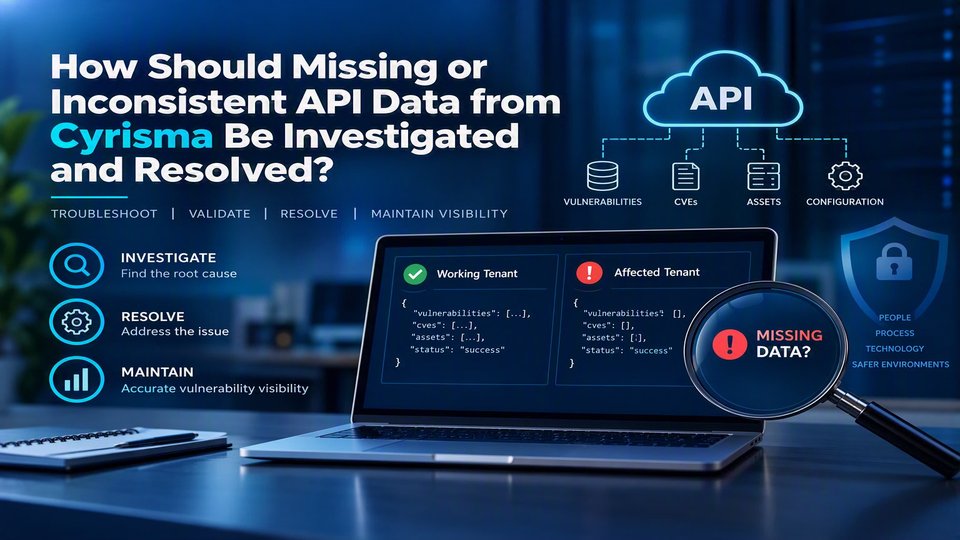
Modern cybersecurity platforms depend on reliable API integrations to collect, process, and report critical security information. When vulnerability, CVE, or asset data appears for some tenants but is missing for others, security teams need a structured process to determine whether the issue is caused by API changes, tenant configuration, permissions, or data availability.
For organizations integrating Cyrisma with security management solutions such as Storage Guardian, investigating inconsistent API data is essential for maintaining accurate vulnerability visibility and effective risk management.
Why Is Cyrisma Vulnerability or CVE Data Missing?
When vulnerability and CVE information is available for one tenant but missing for another, several factors should be investigated.
Potential causes include:
• Different API permissions or authentication settings
• Tenant-specific configurations
• Differences in enabled Cyrisma features
• API endpoint or version changes
• Differences in asset discovery or vulnerability scanning
• Filtering or synchronization rules
• Temporary API service issues
• Vulnerability data that has not yet been generated or synchronized
The first step is to determine whether the missing information originates from Cyrisma itself or from the application consuming the API data.
Compare API Responses Between Tenants
A practical troubleshooting process begins by comparing API responses from a working tenant and an affected tenant.
Security teams should make the same API request against both environments and compare the HTTP status code, response structure, tenant identifiers, available vulnerability fields, timestamps, and returned records.
If the Cyrisma API response does not contain vulnerability or CVE information, the issue may need to be investigated within Cyrisma.
However, if the API returns the expected information but it does not appear in the receiving application, the investigation should move to the integration, data-processing, mapping, or reporting layer.
This distinction can significantly reduce troubleshooting time.
Check for Cyrisma API Changes and Configuration Differences
API integrations can be affected by changes to endpoints, authentication requirements, response formats, field names, parameters, or API versions.
For this reason, organizations should monitor API responses for unexpected structural changes. Even a relatively small change in a response field can prevent vulnerability information from being correctly processed by another system.
Tenant configuration should also be reviewed. Two customers may use the same integration while having different permissions, scanning configurations, enabled services, or asset inventories.
Comparing a working tenant with an affected tenant can help identify these differences quickly.
How Storage Guardian Can Help?
Storage Guardian can provide a centralized approach to managing security information across multiple customers and environments. Its security solutions can help organizations bring vulnerability management, risk tracking, security assessments, and reporting into a more consistent operational workflow.
When Cyrisma API data is inconsistent, Storage Guardian can help separate the troubleshooting process into three areas: data collection, data validation, and risk management.
For example, expected vulnerability and CVE information can be validated during the integration process. Once received, the information can be incorporated into the Storage Guardian Risk Registry, allowing security teams to track identified risks, assign remediation responsibilities, monitor outstanding issues, and maintain historical records.
This helps prevent missing API data from being overlooked simply because a report contains no results.
When Should a Cyrisma Support Ticket Be Created?
If authentication, permissions, tenant configuration, and API requests have been verified but the expected data is still missing, a formal Cyrisma support ticket may be required.
The support request should include the affected tenant, API endpoint, request parameters, timestamp, HTTP response, expected information, actual response, and comparison with a working tenant.
Providing this technical information allows the Cyrisma support team to more efficiently determine whether the issue is related to an API change, backend data availability, tenant configuration, or another platform-level issue.
Build a More Reliable Vulnerability Data Workflow
Missing vulnerability or CVE information should not automatically be treated as an indication that no vulnerabilities exist. Instead, an empty or inconsistent API response should trigger a validation process.
By comparing Cyrisma API responses, reviewing tenant configurations, monitoring API changes, and documenting discrepancies, organizations can identify the source of missing security data more efficiently.
With Storage Guardian's centralized security management and Risk Registry capabilities, organizations can connect vulnerability information with risk tracking, remediation workflows, and customer reporting—helping security teams maintain consistent visibility across multiple environments.


