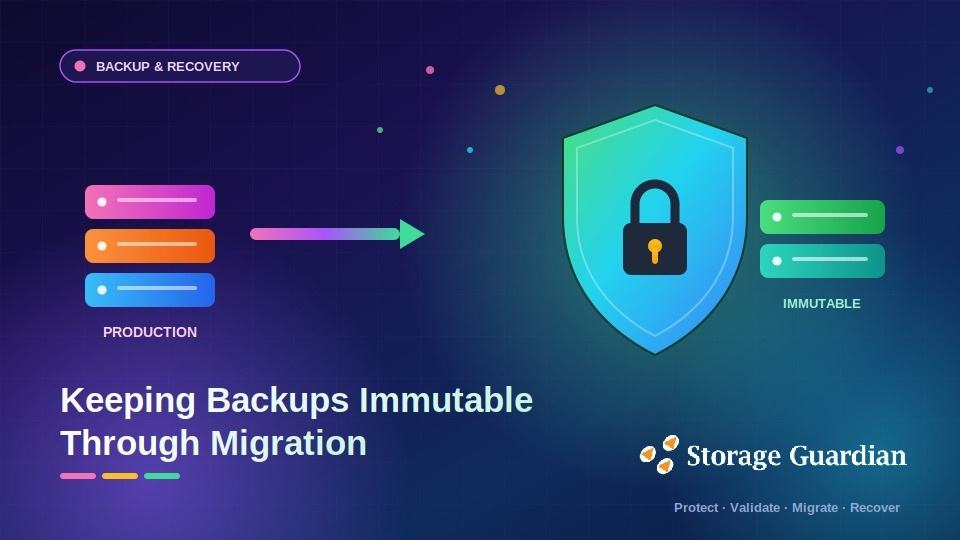
Migrating infrastructure from VMware to Proxmox, between backup platforms, or to the cloud can introduce unexpected risks to your backup and recovery strategy.
Organizations often focus on migrating production workloads, virtual machines, storage, and applications. But one critical question is frequently overlooked:
How do you ensure your backups remain immutable, protected, and recoverable throughout the migration?
The challenge is growing as attackers increasingly exploit vulnerabilities in widely deployed IT and backup infrastructure. Blackpoint Cyber recently highlighted thousands of newly disclosed vulnerabilities and warned that threat actors are increasingly targeting systems that protect critical data.
For organizations undergoing migration, this creates an important reality: your backup infrastructure itself can become a target.
Your Backup Infrastructure Is a Target
Backup systems contain something attackers desperately want: your recovery capability.
Blackpoint recently highlighted CVE-2026-44963, a critical vulnerability affecting Veeam Backup & Replication. According to Blackpoint, exploitation could potentially allow an attacker to execute code on a Veeam server and destroy backups, steal sensitive information, or take control of the backup environment.
This demonstrates why simply having backups is no longer enough.
Your backup infrastructure needs multiple layers of protection—especially during migration, when systems, credentials, repositories, and configurations are changing.
Ransomware Doesn't Wait for Your Migration to Finish
Consider Qilin ransomware, an active ransomware-as-a-service operation.
In an incident investigated by Blackpoint Cyber, attackers used a legitimate signed executable to sideload a malicious DLL containing EDRSandblast, a tool designed to interfere with endpoint security protections. Blackpoint's SOC detected the activity and prevented further damage by isolating affected systems.
The Qilin example demonstrates how sophisticated attackers can attempt to weaken security controls before deploying ransomware.
But even when an attack is stopped, organizations should assume prevention can fail.
If an attacker reaches the backup environment, can your recovery data survive?
That is where immutability becomes critical.
What Is an Immutable Backup?
An immutable backup is protected against modification or deletion for a defined retention period.
If ransomware compromises production and attempts to delete recovery points, an immutable backup provides a protected copy that cannot simply be altered or removed during its protection period.
A ransomware-resilient architecture looks like:
Production → Backup → Immutable Layer → Recovery
But there is an important distinction:
Immutable doesn't automatically mean recoverable.
You also need to know that the backup data exists, remains intact, and can actually be used for recovery.
How Storage Guardian Protects Backups During Migration?
Storage Guardian takes a validation-first approach, combining backup protection, immutability, and validation to help organizations maintain recovery readiness before, during, and after infrastructure changes.
For organizations migrating from VMware to Proxmox or another platform, Storage Guardian addresses three critical areas:
1. Protect — Create an Immutable Layer
Storage Guardian's Veeam-based services and Self-Provisioning Portal provide redundant backup infrastructure with immutable protection, helping protect recovery points from ransomware, accidental deletion, unauthorized access, and tampering.
This creates an additional layer between production systems and the recovery data an organization depends on.
2. Validate — Know What You Have Before Migration
Before migration begins, Storage Guardian's Out-of-Band Validation Tool helps validate existing backup data and establish a baseline of available recovery points.
Instead of assuming that all required recovery data exists, IT teams can verify what is actually available before making changes.
3. Validate Again — Prove Recovery Data Remains Available
After migration, Storage Guardian can help validate the backup environment again to confirm that expected recovery points remain available and that the migration hasn't created gaps in the recovery strategy.
The process becomes:
Protect → Validate → Migrate → Validate → Recover
The goal isn't simply to move data.
The goal is to maintain confidence that the data can still be recovered when it matters.
Immutable Backups + Validation = Stronger Ransomware Protection
A resilient migration strategy shouldn't depend on one security control.
Organizations should combine:
Detection & Response — Identify and contain ransomware.
Secure Backup Infrastructure — Protect the systems managing recovery data.
Immutable Backups — Protect recovery points from deletion and tampering.
Backup Validation — Verify that recovery data remains available.
Recovery Testing — Prove critical workloads can actually be restored.
This layered approach becomes increasingly important as attackers target both production environments and the infrastructure designed to protect them.
Don't Let Migration Create a Recovery Blind Spot
A migration isn't complete simply because workloads are running on the new platform.
A successful migration means:
• Workloads are migrated
• Backups remain protected
• Immutability is maintained
• Retention policies are preserved
• Restore points are validated
• Recovery has been tested
Whether you're migrating from VMware to Proxmox, changing backup platforms, or moving to the cloud, protecting your recovery environment should be part of the migration plan from day one.
Storage Guardian helps organizations strengthen this process with immutable backup infrastructure, the Out-of-Band Validation Tool, Veeam-Self-Provisioning portal, and recovery readiness.
Because when ransomware strikes, the most important question isn't whether your migration was completed, it's whether you can recover.


