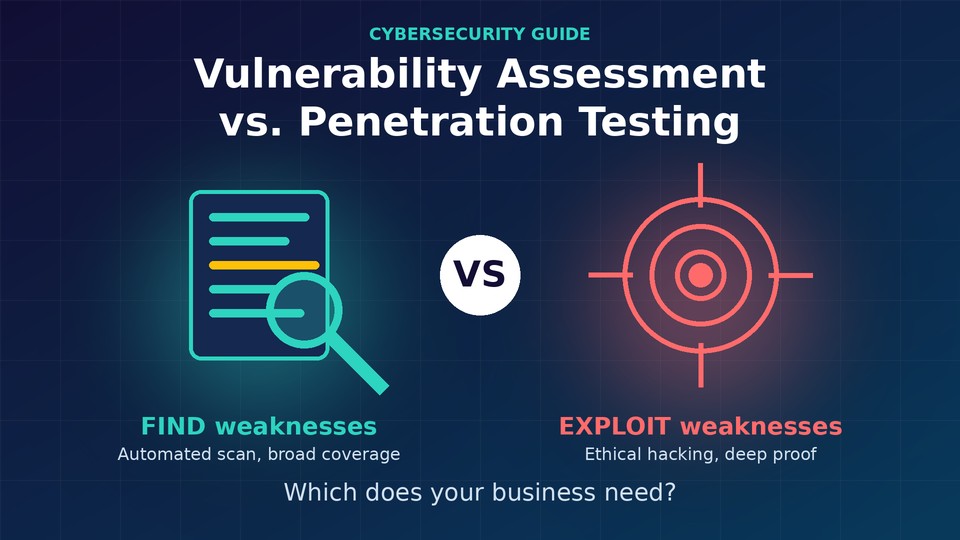
“Vulnerability assessment” and “penetration testing” are often used as if they mean the same thing. They don’t. Knowing the difference helps you spend your security budget wisely and avoid gaps attackers love to exploit.
A vulnerability assessment is a broad, largely automated scan of your systems, networks and applications. It looks for known weaknesses such as missing patches, misconfigurations, outdated software and exposed services. The result is a prioritized list of issues, usually ranked by severity.
Think of it as a health check-up. It’s fast, repeatable and relatively affordable, so many businesses run one monthly or quarterly.
Best for: routine hygiene, compliance requirements, and keeping a constant watch on your attack surface.
Penetration testing (pen testing) goes further. Skilled security professionals act like real attackers and try to exploit weaknesses to see how far they can get. They might chain several small flaws together, bypass controls or reach sensitive data.
Think of it as a stress test. It’s manual, deeper and more expensive, but it shows which vulnerabilities actually matter and what a real breach could look like.
Best for: validating your defenses, testing new applications before launch, and meeting audit or insurance requirements.
For most organizations, the honest answer is both, at different intervals.
Here’s what many guides skip: no test can make you breach-proof. Assessments and pen tests reduce risk, but new vulnerabilities appear daily, and one phishing click or unpatched system can still lead to ransomware, data corruption or an outage.
That’s why a security program needs a safety net, and that’s where Storage Guardian fits in. A data protection company serving businesses since 1999, Storage Guardian provides managed backup, disaster recovery, cyber-resilience and data migration services, built on Veeam Cloud technology and delivered from SOC 2-certified infrastructure.
Here’s how it complements your testing:
The strongest strategy has three layers: find weaknesses with vulnerability assessments, validate them with penetration testing, and recover from the unexpected with reliable backup and disaster recovery.
Not sure where your business stands? Start by reviewing your testing schedule, then check whether you could restore your critical data tomorrow if you had to.
Contact Storage Guardian today for a backup and recovery assessment, and make sure that when the unexpected happens, your business bounces back.


