Migrating VMs from 3rd Party BDR to Veeam Backup & Disaster Recovery? Learn why boot validation and an audit ledger keep corrupted VMs out of production, and how Storage Guardian automates it.
Primary keyword: migrating VMs from 3rd Party BDR to Veeam
The Hidden Risk in Backup Platform Migrations
Switching backup platforms is rarely about the software alone. When you're migrating VMs from 3rd Party BDR to Veeam BDR, you're moving years of restore points that your business may depend on in an emergency. Most teams assume that if a restore job reports "success," the data is good. That assumption is where migrations go wrong.
A completed restore only proves that bits were copied. It doesn't prove the virtual machine will boot, the operating system will mount its volumes cleanly, or the application will start. Corruption can hide in snapshot chains, deduplicated blocks, or incomplete exports, and you often discover it at the worst possible time: during a production cutover or an actual disaster.
What Is Boot Validation?
Boot validation means powering on a restored VM in an isolated environment and confirming it actually works. Instead of trusting job status, you verify the result:
• The VM powers on without errors
• The guest OS reaches a login or ready state
• Virtual disks mount and pass basic integrity checks
• VMware Tools or Hyper-V integration services respond
If a restore point fails any of these checks, you know before it reaches production, not after.
The Intermediate Host Approach
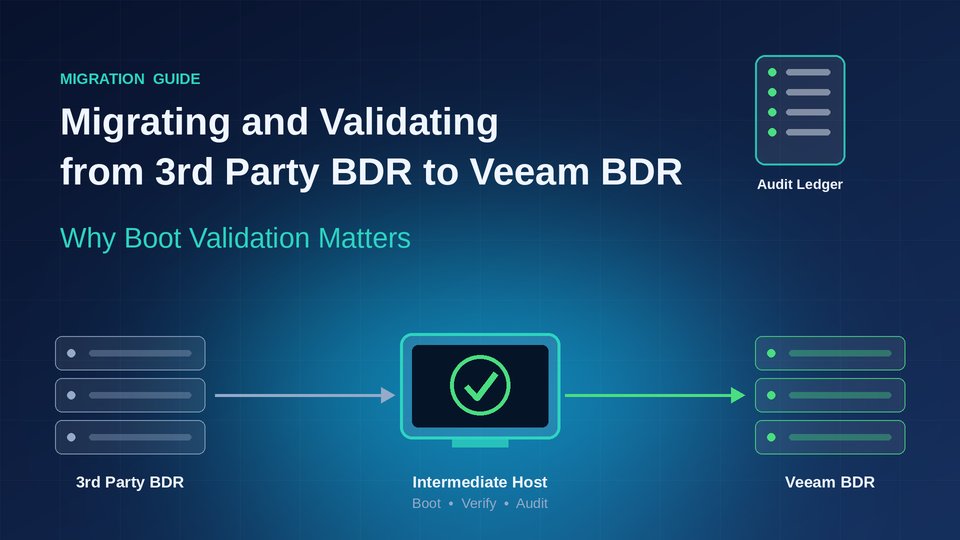
The safest way to validate during a 3rd Party BDR-to-Veeam migration is to restore each restore point to an intermediate host rather than directly into your production cluster. The workflow looks like this:
1. Restore the VM from 3rd Party BDR to an isolated intermediate host.
2. Boot the VM on a sandboxed network so it can't conflict with live systems.
3. Verify OS health, disk integrity, and service availability.
4. Import the validated VM into Veeam BDR as a protected workload.
5. Record the outcome for every restore point.
Because the intermediate host is isolated, a corrupted or misbehaving VM can't cause IP conflicts, Active Directory issues, or data corruption in production. It's a quarantine zone for your backups.
Why an Audit Ledger Changes Everything?
Validation is only half the story. In regulated industries, and in any organization that answers to auditors, you need proof that validation happened. An audit ledger is a tamper-evident record of every restore point tested, including:
• VM name and restore point timestamp
• Validation result (pass or fail)
• Boot time and checks performed
• Who or what ran the validation, and when
With a ledger, a corrupted VM is flagged and held back. A clean VM carries documented evidence that it was verified. When compliance teams ask how you know your migrated backups are trustworthy, you have an answer backed by records instead of assumptions.
How Storage Guardian Automates the Process?
Doing this manually across hundreds of VMs and thousands of restore points isn't realistic. This is where Storage Guardian fits in. Storage Guardian automates the validation workflow during 3rd Party BDR-to-Veeam migrations by:
• Orchestrating restores of each restore point to an intermediate host
• Boot-testing every VM and running integrity checks automatically
• Maintaining an audit ledger of every result for compliance and troubleshooting
• Blocking corrupted VMs from advancing to Veeam BDR or production
The result is a migration where only verified, bootable workloads move forward. Your team spends less time on repetitive testing and more time on the cutover itself.
Best Practices for a Safer Migration
• Validate every restore point you plan to keep, not just the latest one.
• Use isolated networking on the intermediate host to prevent conflicts.
• Prioritize critical workloads such as databases and domain controllers first.
• Keep the ledger as a long-term artifact for audits and post-migration reviews.
• Re-test after import into Veeam to confirm the new backup chain is healthy.
Final Thoughts
Migrating VMs from 3rd Party BDR to Veeam BDR is an opportunity to improve your data protection posture, but only if you can trust what you're moving. Boot validation on an intermediate host proves your restore points work, an audit ledger proves you checked, and Storage Guardian makes the whole process repeatable at scale.
Don't let a corrupted VM be the surprise that derails your migration. Validate first, migrate with confidence.


